



Blog
Annual Calendar vs. Perpetual Calendar: What’s the Real Difference?
Dec
Key Takeaways:
- Annual Calendar (AC): Requires one manual adjustment per year (March 1st); treats February as 30 days
- Perpetual Calendar (QP): Requires no adjustment until Year 2100; accounts for 28/29-day Februarys automatically
- AC invented by Patek Philippe in 1996 (ref. 5035)—not a centuries-old technology
- QP accounts for 1,461-day cycles (4 years); AC uses simpler wheel-and-pinion logic
- Price typically: AC ~$60,000–$150,000 | QP ~$150,000–$500,000+
The Battle of Complications: Solving the Calendar Problem
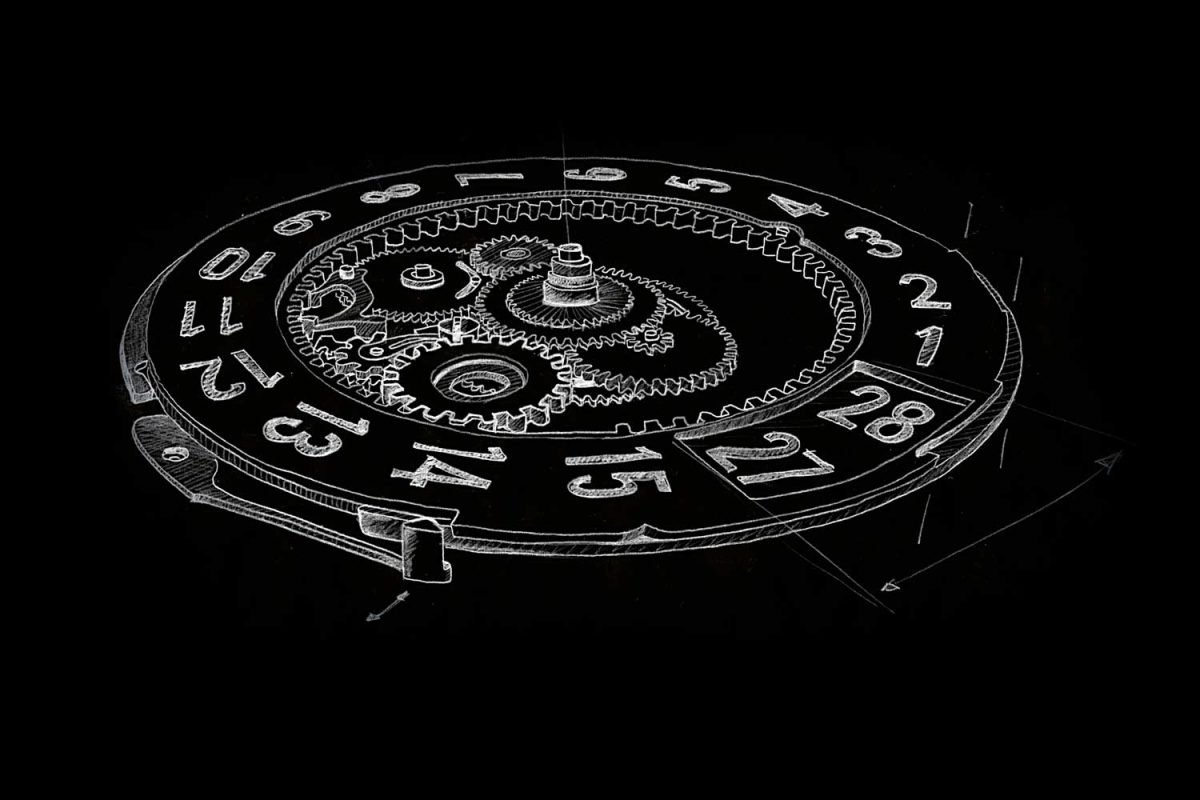
The Gregorian calendar, decreed by Pope Gregory XIII in 1582, created an engineering nightmare for watchmakers. Human months are inconsistent: some have 30 days, others 31, and February rebels with 28 (or 29 every four years). A standard date watch—like a Datejust or Seamaster—is mechanically “dumb”: it counts to 31 every single month, requiring manual correction on April 1st, June 1st, September 1st, and November 1st.
That inefficiency bothered the finest watchmakers for centuries. The perpetual calendar was their answer, but it was expensive, fragile, and mechanically Byzantine. Then, in 1996, Patek Philippe invented something between stupidity and perfection: the annual calendar.
What Is an Annual Calendar (AC)?
The Mechanics: Recognizing 30 and 31 Days
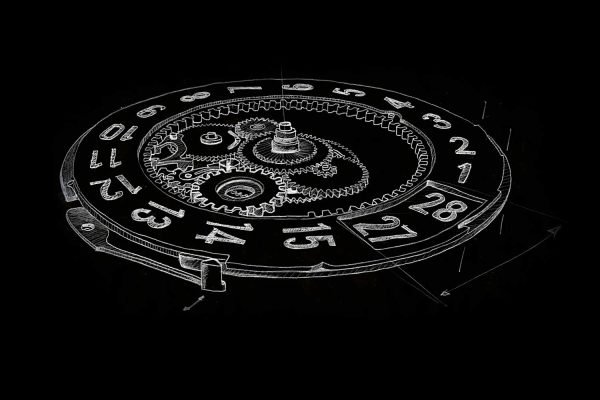
An annual calendar is a mechanism that recognizes which months have 30 days and which have 31 days. Instead of blind 31-day counting like a basic date watch, the AC uses additional wheels and fingers that selectively engage depending on the month.
The system works through two additional fingers on the date-advancing jumper:
- Finger A: Active all year
- Finger B: Active only during April, June, September, and November (the 30-day months)
When these months transition to their 31st and then to the 1st of the next month, Finger B engages slightly earlier, preventing the date from displaying 31 in those months. The calendar advances correctly from April 30th directly to May 1st, without requiring user intervention.
The One Exception: February
Here is the limitation: the annual calendar does not recognize leap years. It treats February as a fixed 30-day month. This means that on March 1st, if February just had 28 days (or 29 in leap years), the owner must manually adjust the date dial backward by one day.
This is the “annual” part of the name—you adjust it once per year, at the very end of February. For the remaining eleven months, the watch is fully automatic.
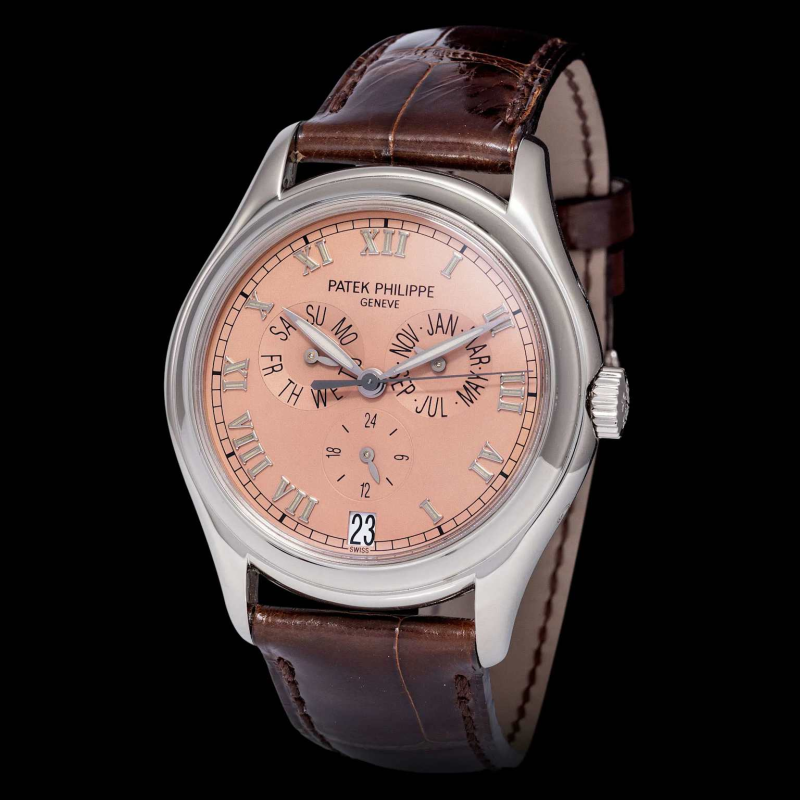
A Modern Invention: Patek Philippe Ref. 5035 (1996)
Here is the critical historical fact: the annual calendar did not exist before 1996. This is not a 19th-century complication; it is younger than the Nintendo 64.
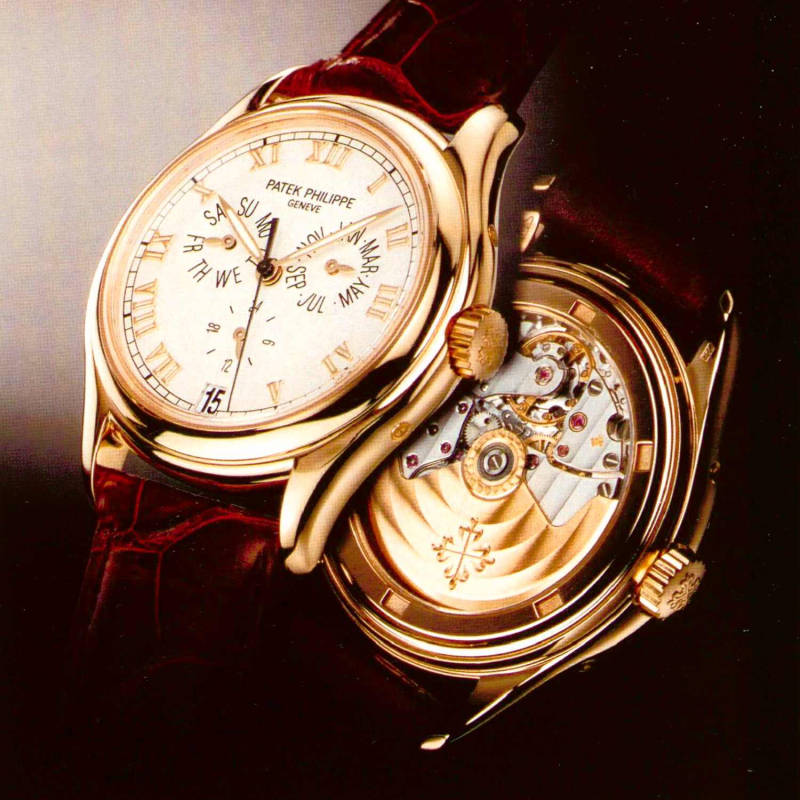
At Baselworld 1996, Patek Philippe unveiled the ref. 5035J—the world’s first serially produced annual calendar wristwatch. The movement, Calibre 315 S QA, featured a patented mechanism (CH685585G) that solved the 30/31-day problem using wheels and pinions instead of the heavy cams and levers required by perpetual calendars.
The 5035 was hailed as “Watch of the Year” by Swiss magazines because it represented intelligent compromise: the perpetual calendar’s practicality without its complexity or six-figure price tag.
What Is a Perpetual Calendar (QP)?
The “Mechanical Brain”: Handling Leap Years
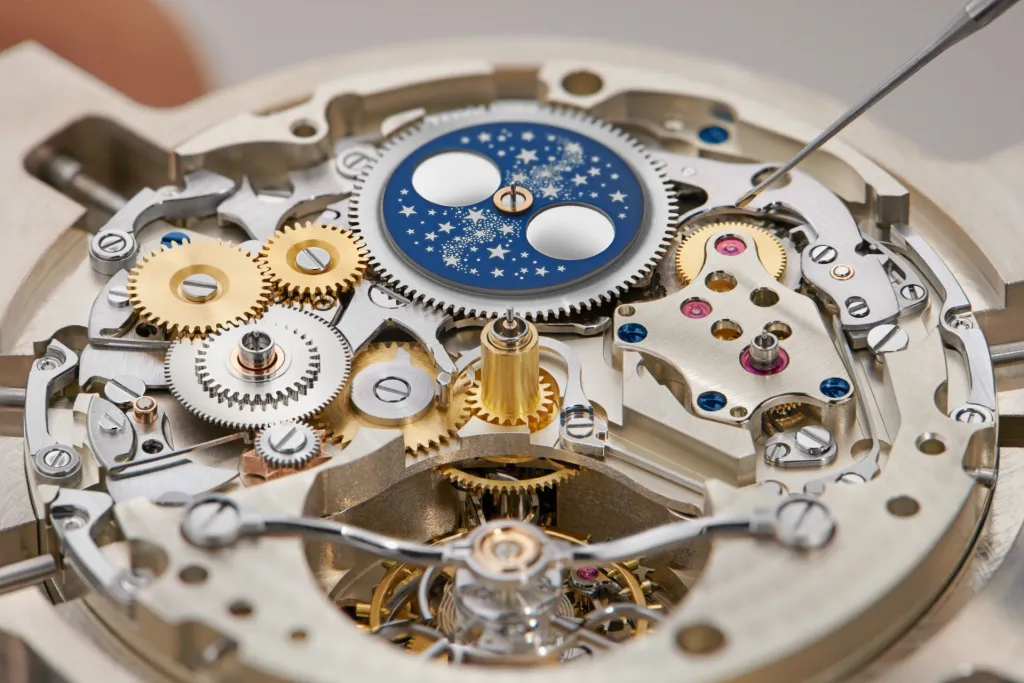
A perpetual calendar is a mechanism with a “memory” of 1,461 days—exactly four years, accounting for one leap year. Inside are dozens of cams, wheels, and levers programmed to recognize that:
- April, June, September, November have 30 days
- All other months except February have 31 days
- February has 28 days normally, 29 every four years
- Every century, the leap year is skipped (except when divisible by 400)
This is achieved through a complex hierarchy of cams—discs with irregular edges that engage followers to trigger specific calendar advances. When mechanical memory is exhausted (1,461 days), everything repeats. The perpetual calendar is, effectively, a mechanical calculation engine.
No Adjustments Until the Year 2100
This is the perpetual calendar’s famous claim: “No manual adjustment until 2100.” And it is technically true—but with a catch.
In the Gregorian calendar, leap years follow a special rule: years divisible by 100 are NOT leap years, except years divisible by 400. So 2000 was a leap year (divisible by 400), but 2100 will NOT be a leap year (divisible by 100, but not 400).
Mechanical perpetual calendars don’t understand this obscure rule. They will treat 2100 as if it should have February 29th, when it actually won’t. On March 1st, 2100, perpetual calendar watches will be off by one day—requiring a manual adjustment to realign with Earth’s actual position.
This is why Jaeger-LeCoultre, Patek Philippe, and others specify: “Accurate until 2100.” After that date, adjustment is needed.
Quantième Perpétuel: The Prestige Factor
“Quantième Perpétuel” is the French term for perpetual calendar, and it carries prestige weight in haute horlogerie. A perpetual calendar represents the peak of watchmaking engineering: hundreds of components, months of hand-finishing, and mechanical problem-solving across decades.
It is the complication that separates “serious collectors” from casual enthusiasts. Owning a perpetual calendar is a statement that you appreciate the machine as art and engineering, not just fashion.
Key Differences Compared: Side-by-Side
| Feature | Annual Calendar (AC) | Perpetual Calendar (QP) |
|---|---|---|
| Adjustment Frequency | Once per year (March 1st) | Once per century (2100 only) |
| Leap Year Recognition | No (treats February as 30 days) | Yes (accounts for 4-year cycle) |
| Mechanical Complexity | High (cam-free wheel/pinion system) | Very High (dozens of cams, wheels, followers) |
| Part Count | ~100–150 additional components | ~200+ additional components |
| Movement Thickness | Moderate (~7–8mm possible) | Thick (~8–10mm+) |
| Annual Price Range | $60,000–$150,000 | $150,000–$600,000+ |
| Fragility | Moderate | Delicate (cams require precision) |
| Service Cost | $3,000–$8,000 | $8,000–$20,000 |
| Winder Anxiety | Low | High (stopping it creates setup problems) |
The Rolex Sky-Dweller: A Special Case
The Saros System Explained
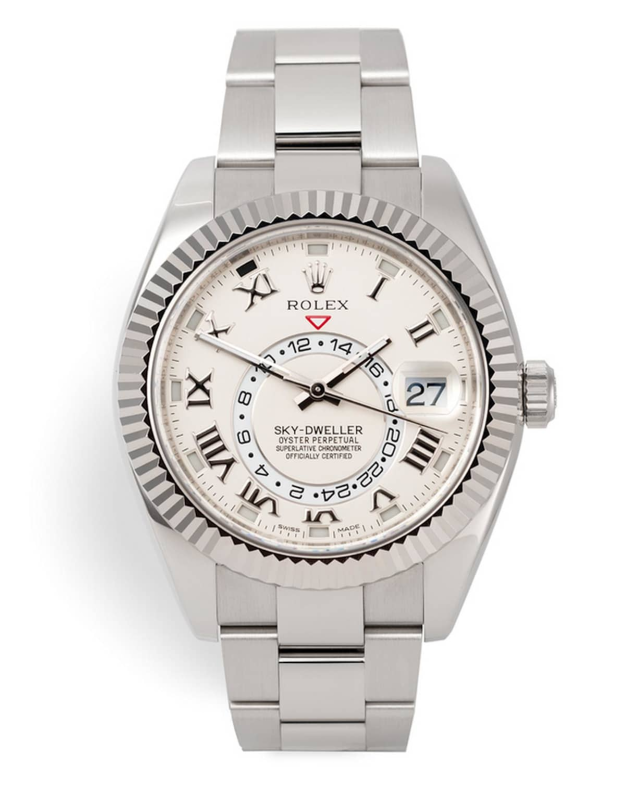
In 2012, Rolex introduced the Oyster Perpetual Sky-Dweller, and with it, a brilliantly simple annual calendar system called SAROS. This mechanism achieves annual calendar function using only 4 additional parts added to a standard date wheel—fewer components than any competitor.
The Saros system uses a planetary gear set (where a satellite gear rolls around a central sun gear) combined with two date-advancing fingers that work in sequence. When a 30-day month ends, the satellite gear is pre-positioned to engage a secondary finger that “double-advances” the date past the non-existent 31st directly to the 1st of the next month.
The engineering elegance lies in exploiting basic orbital mechanics to solve a calendar problem. Rolex named it SAROS after the astronomical cycle of eclipses—a subtle nod to the gear set’s rolling motion.
Month Display via Hour Markers
Instead of a traditional window showing “JAN, FEB, MAR,” the Sky-Dweller uses a hidden month indicator. Above each hour index (12 through 11), there is a small colored aperture. A contrasting disc underneath shows through each aperture selectively:
- Aperture above 1 = January
- Aperture above 2 = February
- … and so on through 12 = December
When the month changes, the disc rotates one position, and a different colored sector appears through the aperture. This solves a critical problem: how do you fit a month display into a dress watch without cluttering the dial?
Only Rolex’s SAROS uses this elegant solution. Other manufacturers use window displays or subdials, which consume dial real estate.
Practicality vs. Prestige: Which One Should You Buy?
The “Winder Anxiety”: Owning a Perpetual Calendar
Perpetual calendar owners live with low-level fear: What if the watch stops?
If a perpetual calendar winds down and stops, getting it restarted is a nightmare. The owner cannot simply wind it and wear it. The cam mechanism must be physically reset to the correct position—March 1st, year YYYY—using specialized tools or pusher sequences that only a certified watchmaker understands.
Stopping a perpetual calendar mid-month can corrupt its calendar state so severely that weeks of adjustment are required to restore function. Some complications cannot be “reset” without disassembling the movement.
Annual calendars have no such anxiety. If you stop an AC and restart it three months later, you just wind it and wear it. The next March 1st, you adjust the date manually, and life continues.
Service Costs and Durability
An annual calendar service typically costs $3,000–$8,000 at a certified service center. A perpetual calendar service runs $8,000–$20,000 because technicians must re-verify the entire calendar state, test the mechanism across multiple months, and ensure cams are perfectly aligned.
Annual calendars are also more durable long-term. They rely on wheels and pinions, which are robust by definition. Perpetual calendars rely on precision-machined cams, which wear differently and are sensitive to lubrication changes over decades.
Why Collectors Call the Annual Calendar the “Smart Choice”
In forums and WhatsApp collector groups, the annual calendar is frequently called the “thinking person’s choice”: you get 95% of the perpetual calendar’s convenience for 40% of the price, with dramatically lower anxiety and service costs.
A collector might own:
- Patek Philippe 5205G (Annual Calendar): $65,000 MSRP → $70,000–$85,000 secondary
- Patek Philippe 5327 (Perpetual Calendar): $150,000 MSRP → $160,000–$210,000 secondary
For $85,000 difference, you gain convenience and durability, but lose prestige. For many wealthy collectors, that trade-off is smart.
Top Models to Consider
Annual Calendars: Best Value
Patek Philippe Ref. 5205G-001
The modern successor to the 5035. Yellow or white gold, MSRP ~$65,000. Considered the “gateway” annual calendar for new collectors.
Rolex Oyster Perpetual Sky-Dweller
Yellow, white, or platinum gold with SAROS annual calendar plus GMT functionality. MSRP ~$40,000–$55,000 depending on metal. The best value annual calendar from a major brand.
IWC Portugieser Annual Calendar
Hand-wound, Portuguese heritage. MSRP ~$50,000–$70,000. Offers annual calendar in a sportier aesthetic than Patek.
Perpetual Calendars: Peak Complication
Patek Philippe Ref. 5327
White gold or platinum. MSRP ~$150,000. Considered the modern standard-bearer of perpetual calendar excellence.
Audemars Piguet Royal Oak Perpetual Calendar
Titanium or gold with moonphase. MSRP ~$180,000–$250,000. Royal Oak’s sporty lines make perpetual calendar feel more contemporary.
Jaeger-LeCoultre Master Ultra-Thin Perpetual
A thin-cased perpetual calendar—rare combination. MSRP ~$140,000–$200,000. For collectors who want complication without bulk.
Is the Leap Year Worth the Price Premium?
For most collectors, no. The annual calendar solves 95% of the problem at 40–50% of the cost. You adjust once per year—a moment of intentional connection with your watch that many collectors actually enjoy.
The perpetual calendar is for purists: those who want to own a piece of mechanical “genius” even if they’ll never use its full capability in their lifetime. It’s jewelry for engineers.
Frequently Asked Questions (FAQ)
Does a perpetual calendar need a battery?
No. Perpetual calendars, like all high horology complications, are purely mechanical. They need to be wound (manually or automatically) like any mechanical watch. No electronics, no batteries, no software.
What happens to perpetual calendars in 2100?
On March 1st, 2100, perpetual calendars will be off by one day because 2100 is not a leap year (though the mechanical calendar thinks it is). The owner must manually adjust the date backward by one day.
Who invented the annual calendar watch?
Patek Philippe in 1996 with the ref. 5035J. Before this date, the annual calendar did not exist as a wristwatch complication. It is one of the youngest major complications in watchmaking.
Is the Rolex Sky-Dweller an annual or perpetual calendar?
The Sky-Dweller is an annual calendar with the SAROS system. It requires manual adjustment once per year at the end of February, like all annual calendars.
Conclusion: The Leap Year Worth Understanding
The annual calendar versus perpetual calendar debate is, at its core, about compromise versus perfection. The annual calendar is Patek’s genius compromise: it solved the problem 99% of the way with half the complexity. The perpetual calendar is mechanical magic—a complication that, while practical, exists primarily as an intellectual achievement.
For your next haute horlogerie purchase, both are excellent choices. But now you understand the mechanics, the history (AC is newer than you think), and the real cost of that extra one percent of convenience. Choose wisely.
 Free Shipping for all orders